Why three cities in seven days actually works
Seven days is a tight window for Italy, and most people who try to add a fourth city end up shifting hotels every other night and seeing the inside of more train carriages than churches. Rome, Florence, and Venice work because of one structural fact: high-speed trains connect them in straight, fast lines. Rome to Florence runs about 90 minutes. Florence to Venice runs roughly two hours and five minutes. You spend less time in transit than most travellers spend in airport security at home.
The trip splits naturally into thirds. Three nights in Rome covers the ancient layer, the Vatican, and an evening in the centro storico. Two nights in Florence lets you see the Renaissance core and either a Tuscan day trip or a deeper museum afternoon. Two nights in Venice covers the lagoon city without the typical day-tripper rush, including one early morning when the calli are quiet enough to hear your own footsteps on the stones.
This guide assumes a first visit, no rental car, and reasonable fitness for daily walking of six to twelve kilometres. If anyone in your group has knee or back limits, the Florence and Venice days will hit hardest because both cities ban most vehicles in the centre. For the broader country context, see our things to do in Rome and things to do in Florence guides.
Days 1 and 2: Rome (ancient core, Vatican, evening centro)
Land at Fiumicino (FCO) or, if you flew low-cost, Ciampino (CIA). The Leonardo Express train runs FCO to Roma Termini in 32 minutes for €14 one way; Ciampino uses the SIT Bus or a regional train via Ciampino station. Drop bags at your hotel near Termini, Piazza Repubblica, or Trastevere. Pick one neighbourhood and stay the full three nights. Switching hotels mid-stay in Rome wastes a half-day.
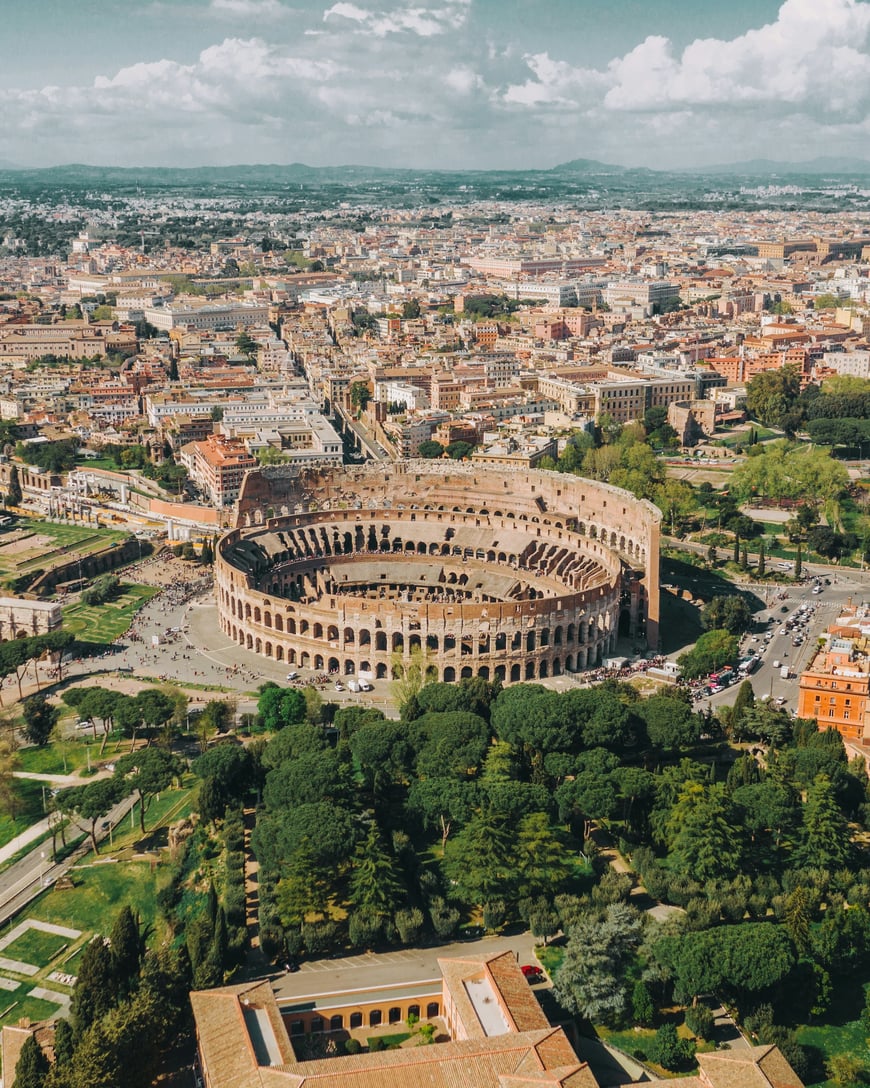
Day 1 afternoon and evening: walk to Piazza della Repubblica, then south through the Forum area for orientation. Skip the queues today. Eat at a trattoria in Monti rather than going inside any museum. Roman jet-lag is real, and the Colosseum at sunset costs the same as the Colosseum at 9 a.m. but cuts your queue patience in half.
Day 2 morning, Vatican: book the Vatican Museums for the 8 a.m. or 8:30 a.m. entry slot and aim to be inside before 8:15. Standard adult ticket is €20, plus €5 if you booked online for a fixed time slot. The route runs through the Pio-Clementino, the Gallery of Maps, the Raphael Rooms, and exits via the Sistine Chapel. From the Sistine, take the side door for groups out to St Peter’s Basilica and skip the basilica’s separate security queue (the door is unmarked but staff will direct you if you ask for “exit to Saint Peter’s”). Allow three and a half hours total.
Day 2 afternoon, ancient Rome: use the Roma Pass (€52 for 72 hours) which covers Colosseum, Forum, and Palatine plus public transport, and lets you book the Colosseum entry online for a €2 fee. The three sites share one ticket; budget three hours for all three. End at Piazza Venezia and walk to Trevi Fountain, the Pantheon (entry €5 for non-residents), and dinner near Piazza Navona. Two scheduling rules: the Vatican Museums close on Sundays except the last Sunday of the month (9 a.m. to 2 p.m., free entry, very crowded). The Wednesday Papal Audience closes off St Peter’s Square until around 12:30 p.m., so plan basilica visits for the afternoon if your dates include a Wednesday.
Day 3: Train to Florence and first afternoon
Check out by 11. Take a Trenitalia Frecciarossa or an Italo from Roma Termini to Firenze Santa Maria Novella. The ride is 91 to 102 minutes, depending on the service. Book at least three weeks ahead for €19.90 to €29 in Standard or Smart class; same-day walk-up costs €70 to €90. Both carriers leave from Termini, but Italo also stops at Tiburtina, which can be closer if you stayed near Piazza Bologna. Keep luggage with you; both trains have overhead racks and an end-of-carriage stack.
Arrive in Florence by early afternoon. Santa Maria Novella station is a 10-minute walk from the Duomo. Drop bags, then walk to Piazza del Duomo for the cathedral exterior, the baptistery, and Giotto’s bell tower. The Duomo complex uses combined tickets (€20 to €30 depending on inclusions) and dome climbs need separate timed reservations made at least two weeks in advance. If you didn’t reserve the dome, do the cathedral exterior loop and save energy for tomorrow. End the day at Piazzale Michelangelo for sunset. The walk up takes 25 minutes and crosses Ponte Vecchio. The view earns the climb.
Days 4 and 5: Florence and a Tuscan day trip
Day 4 morning, Uffizi: reserve the Uffizi for an 8:15 a.m. or 8:30 a.m. slot. From January 2026, full-price entry is €25 for morning visits and €16 from 4 p.m. onward. The booking fee is €4 online (free if you buy at the window, but the morning queue can run an hour in shoulder season). Plan two and a half hours. The Botticelli rooms, the Leonardo room, and the Caravaggio cabinet are the three sections worth slowing down for. Lunch at a small place near Piazza della Signoria, then walk to the Accademia for Michelangelo’s David in the afternoon (€16 standard, €4 booking). For more Florence options, see our Florence sightseeing guide.
Day 4 evening: aperitivo around Santo Spirito or the Oltrarno. The crowd is mostly local, the prices drop a couple of euros, and the bars stay open later than the tourist core.
Day 5, choice of two paths.
Path A, deeper Florence. Pitti Palace and Boboli Gardens in the morning (combined Uffizi + Pitti + Boboli ticket is €40, valid five days), then San Lorenzo Market for lunch, then the Bargello for sculpture in the afternoon. Stays compact; no train.
Path B, day trip to Siena and San Gimignano. Skip Pisa unless the leaning tower is on your bucket list; the town is small and most travellers spend 90 minutes there and feel the trip wasn’t worth the train fare. Siena and San Gimignano give you a Gothic cathedral, a medieval piazza, and a hill town with intact 12th-century towers. A small-group bus tour (departures from Piazza Stazione, around €70 to €90 per person) is cheaper than renting a car for one day and handles the awkward bus connection between the two towns. Tuscany has more to offer if you have time; castles in Tuscany covers the wider region.
Day 6: Train to Venice and arrival
Florence Santa Maria Novella to Venezia Santa Lucia takes about two hours and five minutes on a Frecciarossa or Italo. Book early for €25 to €35; day-of fares climb to €80. Step off the train into the Grand Canal: Santa Lucia opens directly onto the water, and the vaporetto (ACTV public boat) lines run from the steps outside.
If you’re arriving on a 2026 weekend between April 3 and July 26, between 8:30 a.m. and 4 p.m., daytrippers without an overnight booking pay a €5 access fee (€10 if you pay last-minute). With a hotel reservation in the historic centre you’re exempt; show your booking when registering for your QR code at cda.veneziaunica.it.
Spend the rest of the day walking. Walking is the only way to learn Venice. Get lost on purpose between Cannaregio and the Rialto. Eat cicchetti (small bites) at a bacaro standing at the bar; this is dinner for locals and costs €2 to €4 per piece with a glass of ombra wine. See Italian food culture for what to order across the country.
Day 7: St Mark’s, Rialto, and departure
The early morning is the gift Venice gives people who slept in the city. Walk to Piazza San Marco before 8 a.m. The square is empty except for cleaners and pigeons. The light on the Basilica’s mosaics changes minute by minute through the eastern facade. St Mark’s Basilica opens at 9:30 a.m. Monday to Saturday, 2 p.m. on Sundays. Standard entry is €3 for the basilica and €7 to €15 for the Pala d’Oro, treasury, and bell tower add-ons. Doge’s Palace runs €30 with a museum-pass option.
If you want a gondola, the official daytime fare is €90 for 30 minutes (9 a.m. to 7 p.m.) and €110 for 35 minutes after 7 p.m. The price is per gondola, up to five people, set by the city. Quiet back canals away from St Mark’s give the better experience. A traghetto crossing of the Grand Canal at one of seven points is €2 if you only want a brief gondola-style ride for the photo. For more on the lagoon, our things to do in Venice covers the museum sites in detail.
Trains to Venezia Marco Polo airport go via the Alilaguna boat (€15, one hour) or ATVO bus from Piazzale Roma (€10, 20 minutes). Treviso airport, used by Ryanair and others, is 40 minutes by ATVO bus (€12). Allow three hours from your hotel to the airport gate.
Trains, passes, and which carrier to pick
Italy’s two high-speed operators run the same Rome-Florence-Venice corridor, often within minutes of each other. Trenitalia Frecciarossa uses four classes: Standard, Premium, Business, and Executive. Italo uses four classes too: Smart, Comfort, Prima, and Club Executive. Smart and Standard are roughly equivalent. Prima and Business are the productivity-class equivalents. Club Executive and Executive are the pointed-end cabins with three-across seating, lounge access at major stations, and a meal service.
Practical differences: Italo only runs from Roma Tiburtina and Termini in Rome (skipping smaller stations), and from Firenze SMN and Venezia Santa Lucia. Trenitalia covers more secondary stations across Italy, useful only if you extend to smaller towns. Both have free Wi-Fi, both let you bring two large bags plus carry-on without a fee, and both refund or change tickets up to 60 minutes before departure for an admin fee that varies by fare class.
The fare ladder works the same way on both: Super Economy (or Low Cost on Italo) is the cheapest, non-refundable; Economy allows date changes for a fee; Base or Flex is fully flexible. Booking opens 90 to 120 days out. Rome to Florence on Frecciarossa Standard runs €15 to €20 four months ahead, climbing to €70 to €80 the morning of departure. The same is true Florence to Venice. Book each leg as soon as you commit to dates.
Roma Pass: €52 for 72 hours covers Colosseum-Forum-Palatine, public transport, and one or two free museums depending on which sites you pick. Roma Pass does not cover the Vatican; the Vatican is a separate jurisdiction inside the city. Worth it if you’ll do Colosseum + Forum + Palatine + at least two metro rides. If you only walk the centro, the pass loses to single tickets.
Firenze Card: €85 for 72 hours, covers Uffizi, Accademia, Duomo, Bargello, Pitti, plus most other Florence museums. Worth it only if you visit four or more major museums. Two-museum visitors pay less by buying singles.
Where to stay in each city
Rome has four sensible neighbourhoods for a first visit. Termini-Repubblica is the practical choice: walking distance to most things, every train line out of the city, slightly grittier at night. Monti sits closer to the Forum and runs quieter, with bars favoured by Roman thirty-somethings. Trastevere trades a 25-minute walk to the Forum for the best dinner streets in the city. Borgo, the wedge between the Vatican and Castel Sant’Angelo, suits travellers who want the Vatican on Day 2 morning and don’t mind walking back across the river for evenings.
Florence is small enough that any hotel inside the historic centre puts you within 12 minutes of the Duomo. The riverbank south of Piazza della Signoria stays quieter than the cathedral pocket. Look around Santa Croce or Sant’Ambrogio for working-neighbourhood feel.
Venice rewards staying in the centro storico over Mestre on the mainland. Mestre saves about €60 a night, but you lose the morning quiet that is the best thing about a Venice overnight. Cannaregio, San Polo, and Castello are all good first-visit choices. Avoid hotels right on Piazza San Marco unless price isn’t a factor; you pay heavily for the address.
What this trip actually costs
Approximate per-person budgets, two travellers sharing a room, all attractions and trains included, before flights:
- Budget tier (€95 to €130 per day): hostels or two-star hotels, lunch from bakeries and street food, dinner at a casual osteria, public transit only, museums booked in advance for cheaper slots.
- Mid tier (€180 to €240 per day): three-star hotels in central neighbourhoods, sit-down meals twice a day, occasional taxi, all major attractions, one gondola or one premium experience.
- Comfort tier (€340+ per day): four-star hotels, restaurant dining, private guided Vatican entry, one extended gondola ride, premium train classes between cities, taxi to airport.
Recurring fixed costs: Vatican €25 with booking, Colosseum-Forum-Palatine €18 (or via Roma Pass), Uffizi €25 + €4 booking, Accademia €16 + €4 booking, St Mark’s combo €15 to €20, gondola €90 to €110. Train fares booked early total €40 to €60 for the two intercity legs; same fares booked late hit €150 to €170. The single biggest variable is when you book the trains.
When to come
Mid-April to mid-June and mid-September to late October are the structural sweet spots: warm enough for evening dinners outside, cool enough for daytime walking, museums open with shorter queues than the July-August peak. July and August are hot in Rome (mid-30s Celsius), crowded everywhere, and many small Roman businesses close around the August 15 Ferragosto holiday. November to March is a different trip: shorter daylight, fewer tourists, real prices on hotels (often half), gondola rides feel very cold, but St Mark’s Square in fog is something the summer crowd never sees. The Venice access fee only applies during the high-season weekends listed above; off-season visits face no such charge. Carnevale in Venice falls in February and is the one winter exception where you should book months ahead.
Variants: 5 days, 10 days, or run the trip in reverse
5-day cut: drop one Florence day. Rome stays at three nights, Florence drops to one (skip the day trip and the second museum afternoon), Venice keeps two. The day trip to Siena is the first thing to cut because it costs a full day and adds a city the rest of the trip doesn’t reinforce.
10-day extension. Add three days to either end. Best three options:
- Cinque Terre (after Florence, before Venice): two nights in Vernazza or Monterosso. Coastal hiking, swim stops, no major museums. Best if you want a complete change of register.
- Naples plus Pompeii (after Rome, before Florence): two nights in Naples with a Pompeii day trip. Best if Roman history was the reason you came in the first place. Skip if your group dislikes intense urban environments.
- Lake Como or Verona (after Venice): one night in Verona for the arena and Romeo’s balcony, or two nights at Lake Como out of Varenna. Best if you want a softer landing before the flight home.
Reverse direction (Venice to Rome): if you’re flying into Milan Malpensa or Venice, run the trip Venice (2 nights), Florence (2 nights), Rome (3 nights). This works better than people think, because Rome’s evening culture and late-night dining make a stronger close than Venice’s quiet streets after 9 p.m. The train logistics are identical, just reversed.
Common questions
Do I need to book the Vatican and Uffizi in advance?
Yes for both, ideally three weeks out, especially April through October. Walk-up entry exists but the queues run two to three hours.
Is the Colosseum included with the Roma Pass?
Yes, with a €2 booking surcharge. Reserve the time slot online; Roma Pass plus walk-up to the Colosseum still requires the timed booking.
Can I do this trip without speaking Italian?
Yes. Restaurant and ticket staff in tourist areas all use English. A few phrases (per favore, grazie, vorrei, il conto) earn warmer service.
Should I rent a car?
No, not for this itinerary. All three city centres are pedestrian or vehicle-restricted (ZTL zones in Italian) with serious fines for entering by mistake. Trains beat driving city to city.
How early should I book the train tickets?
As soon as the schedule opens (90 to 120 days before travel) for the cheapest fares. Both Trenitalia and Italo open the same window.
What if I only have 4 days?
Pick one of the three cities and do it properly, or pick Rome plus a day in Florence. Three cities in four days is movement without contact.
Sources
Operational facts in this guide cross-checked against the providers and authorities below. Prices and entry policies move; the live links carry the current numbers.
- Italo – Smart, Comfort, Prima, and Club Executive class definitions and live fares for the Rome-Florence and Florence-Venice high-speed routes.
- Trenitalia – Frecciarossa Standard, Premium, Business, and Executive class details and the Super Economy / Economy / Base fare ladder.
- Vatican Museums (Musei Vaticani) – opening hours, Sunday and last-Sunday-of-the-month rules, online booking surcharge, and 2026 closure dates.
- Uffizi Galleries – the new January 2026 split-fare model (full-price morning entry vs reduced evening entry from 4 p.m.) and the combined Uffizi-Pitti-Boboli ticket terms.
- Roma Pass – 72-hour pass scope, Colosseum booking-fee policy, and the explicit exclusion of the Vatican Museums.
- Firenze Card – 72-hour Florence museum pass coverage and break-even threshold.
- ENIT (Italian National Tourism Agency) – regional travel notes, public-holiday closures, and Ferragosto guidance for August trip planning.