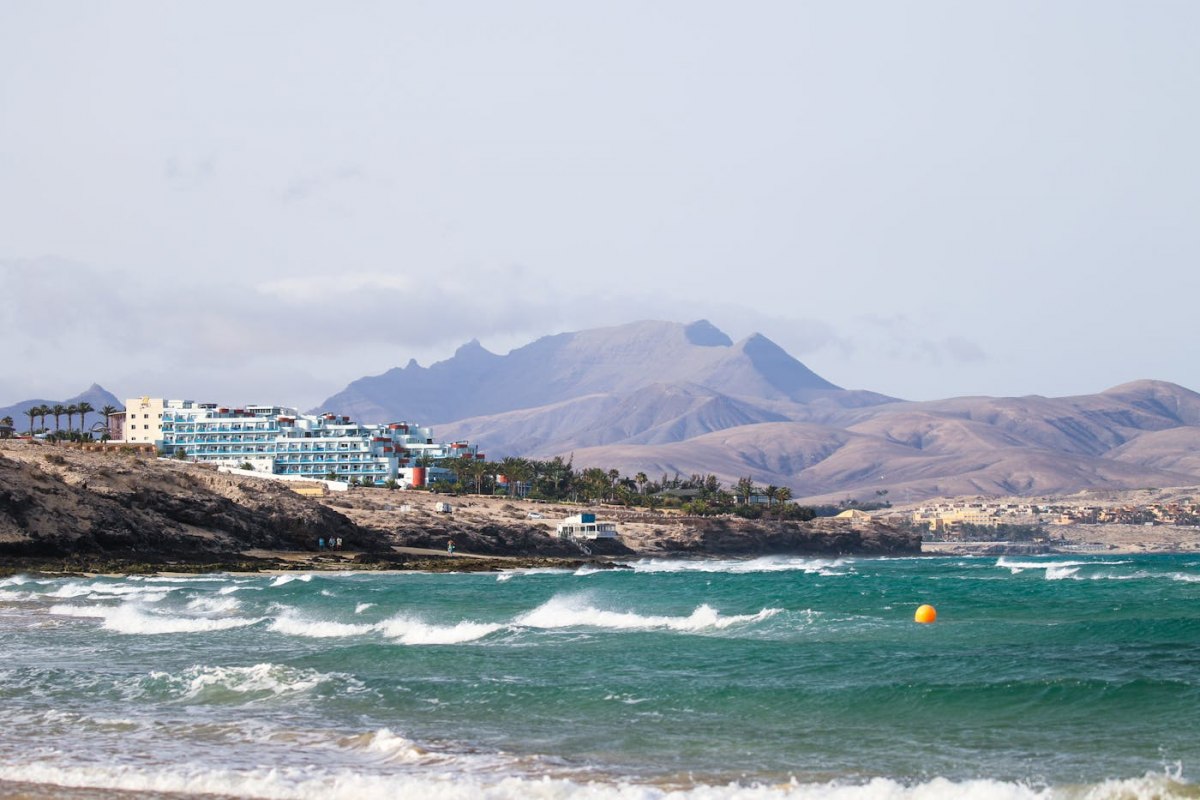
The Jandia peninsula is the wild, mountainous tail of Fuerteventura, a protected natural park that holds the island’s highest peak, its most famous wild beach, an endemic plant found nowhere else on Earth, and a wartime mystery. It is also where the island’s longest sands and biggest resorts sit, so Jandia combines easy beach holidays with some of the emptiest country in the Canaries. This guide covers what to see across the peninsula. For the wider island, see our Fuerteventura travel guide.
A protected peninsula
The Jandia peninsula juts out from the south-western corner of the island and covers around 200 square kilometres, of which about 144 are protected as the Jandia Natural Park, given park status in 1987. It is a desert landscape of bare mountains, long beaches and almost no development away from the resort strip, joined to the rest of Fuerteventura by the narrow sandy isthmus at La Pared, the same neck of land where a wall once divided the island’s two aboriginal kingdoms. The protection is the reason so much of the peninsula remains wild, and it shapes everything from where you can drive to which plants survive here. The result is a striking split personality: a few kilometres of developed resort coast at the eastern end, and beyond it some of the emptiest, most dramatic country anywhere in the Canary Islands, all within the same peninsula.
Pico de la Zarza, the island’s roof
The peninsula rises to Pico de la Zarza, also called Pico de Jandia, the highest point on Fuerteventura at 807 metres. A well-trodden hiking trail climbs to the summit from near Morro Jable, taking around two and a half hours up, and on a clear day the reward is one of the great island views: the long wild sweep of Cofete beach and the Barlovento coast far below on the ocean side, with the resort coast behind. It is the island’s classic walk, covered alongside the other routes in our walking guide, and it needs proper shoes, sun cover and water given the climb and the total lack of shade.
Cofete and the Villa Winter mystery
On the ocean side of the mountains lies Cofete, among the most spectacular wild beaches in the Canaries: a vast, empty arc of sand backed by sheer mountains, with strong currents that make it a place to walk rather than swim. Above the beach stands Villa Winter, a remote stone house built by the German engineer Gustav Winter, who owned the whole Jandia peninsula in the mid-twentieth century and fenced it off from the rest of the island until the 1950s. What went on behind that fence during and after the Second World War has never been fully explained, and the house has drawn legends of secret submarine bases and Nazi hideouts ever since. The documented facts are thinner than the myths, but the isolation gives the stories their grip. Reaching Cofete means a long, rough, unpaved track best tackled on a guided jeep safari, since hire-car contracts usually forbid it.
The lighthouse and the southern tip
At the far south-western point of the peninsula stands the Faro de Punta Jandia, a lighthouse marking the island’s most remote corner, which now houses the interpretation centre for the natural park. The drive or ride out to it crosses raw, empty country and ends at the small fishing settlement of Puerto de la Cruz, where a couple of simple restaurants serve fresh fish at the literal end of the road. It is among the most genuinely remote corners of the island, and the contrast with the resort coast an hour away could not be sharper.
The endemic plant and the wildlife
Jandia’s protection guards some unique nature:
- The cardon de Jandia: a spurge, Euphorbia handiensis, a cactus-like endemic that grows wild only here on the whole planet, and is the symbol of the natural park and one of the island’s botanical treasures.
- The houbara bustard: the rare steppe bird that is the island’s faunal symbol can be seen on the plains around the La Pared isthmus, covered in our birdwatching guide.
- Marine life: the deep waters off the south are the island’s best for whales and dolphins, with trips from Morro Jable in our boat trips guide.
The history of the peninsula
Jandia carries a long and unusual human story for such empty country. Before the conquest it was one of the island’s two aboriginal kingdoms, ruled by the king Ayose from the south while Guise ruled Maxorata in the north, the two divided by a wall across the La Pared isthmus that still gives the place its name, meaning the wall. After the Norman conquest the peninsula stayed thinly populated, grazed by goats and worked by a few fishing families at Cofete and the southern coves. Its strangest chapter came in the twentieth century, when the German engineer Gustav Winter acquired control of the whole peninsula and fenced it off from the rest of the island until the 1950s, building the isolated Villa Winter above Cofete. The secrecy of that private, fenced estate during and after the Second World War is the root of the legends that still cling to the house. Only with the creation of the natural park in 1987 did the peninsula’s future shift decisively from private and military uses toward conservation, which is why it survives today as one of the wildest protected landscapes in the Canaries.
The beaches of Jandia
The peninsula holds the island’s longest and finest sands:
- Playa de Sotavento: a vast east-facing beach with a tidal lagoon, the centre of the island’s windsurfing and kitesurfing scene, in our windsurfing guide.
- Playa del Matorral: the long resort beach at Morro Jable, backed by the protected salt marsh, covered in our Morro Jable guide.
- Cofete and Barlovento: the wild, surf-battered ocean beaches on the far side of the mountains, beautiful but dangerous for swimming.
Visiting the Jandia peninsula
- Base yourself in the south: Morro Jable, Jandia Playa or Costa Calma put the peninsula on your doorstep, covered in our Jandia hotels guide.
- Hire a car or take a tour: the resort beaches are easy, but Cofete, Punta Jandia and Pico de la Zarza need a four-wheel drive, a guided tour or a serious walk.
- Respect the park: stay on the tracks and trails, since the desert ground and the endemic plants recover badly from damage.
- Carry water and sun cover: there is no shade and little shelter once you leave the resorts, and the wind can be strong.
- Allow a full day for the wild side: Cofete, Punta Jandia and Pico de la Zarza each eat up most of a day given the slow tracks and the walking, so do not try to cram them together.
Frequently asked questions
What is the Jandia peninsula?
The wild, mountainous southern tail of Fuerteventura, much of it protected as the Jandia Natural Park since 1987. It holds the island’s highest peak, its longest beaches, the wild Cofete coast and an endemic plant found nowhere else.
How high is Pico de la Zarza?
Pico de la Zarza, the highest point on Fuerteventura, reaches 807 metres. A trail climbs to the summit from near Morro Jable in about two and a half hours, with views over Cofete and the wild west coast.
What is Villa Winter?
A remote stone house above Cofete beach, built by the German engineer Gustav Winter, who owned and fenced off the Jandia peninsula in the mid-twentieth century. Its wartime history is unexplained and has spawned many legends.
How do you get to Cofete?
By a long, rough, unpaved mountain track from Morro Jable, best done on a guided jeep safari or in a four-wheel drive, since most hire-car contracts exclude the road and void insurance on it.
What is the cardon de Jandia?
An endemic spurge, Euphorbia handiensis, a cactus-like plant that grows wild only on the Jandia peninsula and is the symbol of the natural park.
Is Cofete beach safe for swimming?
No. Cofete is a wild, open ocean beach with strong currents and no lifeguards, so it is a place to walk and admire rather than swim. For safe swimming, head to the sheltered resort beaches at Morro Jable, Sotavento or, in the north, the El Cotillo lagoons.
How do you explore the Jandia peninsula?
The resort beaches and Morro Jable are easy by car or transfer, but the wild interior, Cofete, Pico de la Zarza and Punta Jandia, needs a four-wheel drive, a guided jeep safari or serious walking, since the tracks are rough and largely off-limits to ordinary hire cars.
Sources and further reading
- Saladar de Jandia and southern wetlands, Ministerio para la Transicion Ecologica
- Reserva de la Biosfera Fuerteventura
- Cabildo de Fuerteventura, island council